Exercise is Medicine During Perimenopause and Menopause
"Movement is one of the most powerful medicines available—but only if we choose the right type." If you've noticed your body feels different during perimenopause or after menopause, you're not imagining it.
Many women describe feeling stronger one year and then suddenly noticing that they're gaining weight more easily, taking longer to recover from exercise, developing persistent aches and pains, or feeling less confident in their bodies. These changes can be frustrating, particularly if you've always lived an active lifestyle.
The good news is that while hormones change, your bodyremains remarkably adaptable. One of the most effective ways to manage manysymptoms of perimenopause and menopause is something that is available toalmost everyone: exercise.
In fact, exercise is now recognised as one of the first-linestrategies for improving physical function, maintaining bone and muscle health,reducing the risk of chronic disease, and supporting mental wellbeing duringmidlife and beyond (The Menopause Society, 2023; Daly et al., 2023).
Why does exercise become even more important?
As oestrogen levels fluctuate and eventually decline, womennaturally begin to lose muscle mass, bone density and strength. This cancontribute to:
Reduced m"Movement is one of the most powerfulmedicines available—but only if we choose the right type."
If you've noticed your body feels different duringperimenopause or after menopause, you're not imagining it.
Many women describe feeling stronger one year and thensuddenly noticing that they're gaining weight more easily, taking longer torecover from exercise, developing persistent aches and pains, or feeling lessconfident in their bodies. These changes can be frustrating, particularly ifyou've always lived an active lifestyle.
- muscle strength
- Increased body fat, particularly around the abdomen
- Lower bone density
- Joint aches and stiffness
- Tendon pain
- Reduced balance
- Increased isk of falls and fractures
- Lower energy levels
Although these changes are common, they are not inevitable. Research consistently shows that regular exercise can slow,reduce and, in many cases, reverse many of these changes (Bull et al., 2020;Daly et al., 2023).
Not all exercise has the same benefits
One of the biggest misconceptions is that all exerciseprovides the same health benefits.
Walking is excellent for your heart, lungs and mentalwellbeing, but it is generally not enough on its own to maintain musclemass or improve bone density after menopause (Giangregorio et al., 2022).
Instead, women benefit most from combining several differenttypes of exercise throughout the week.
1. Progressive strength training
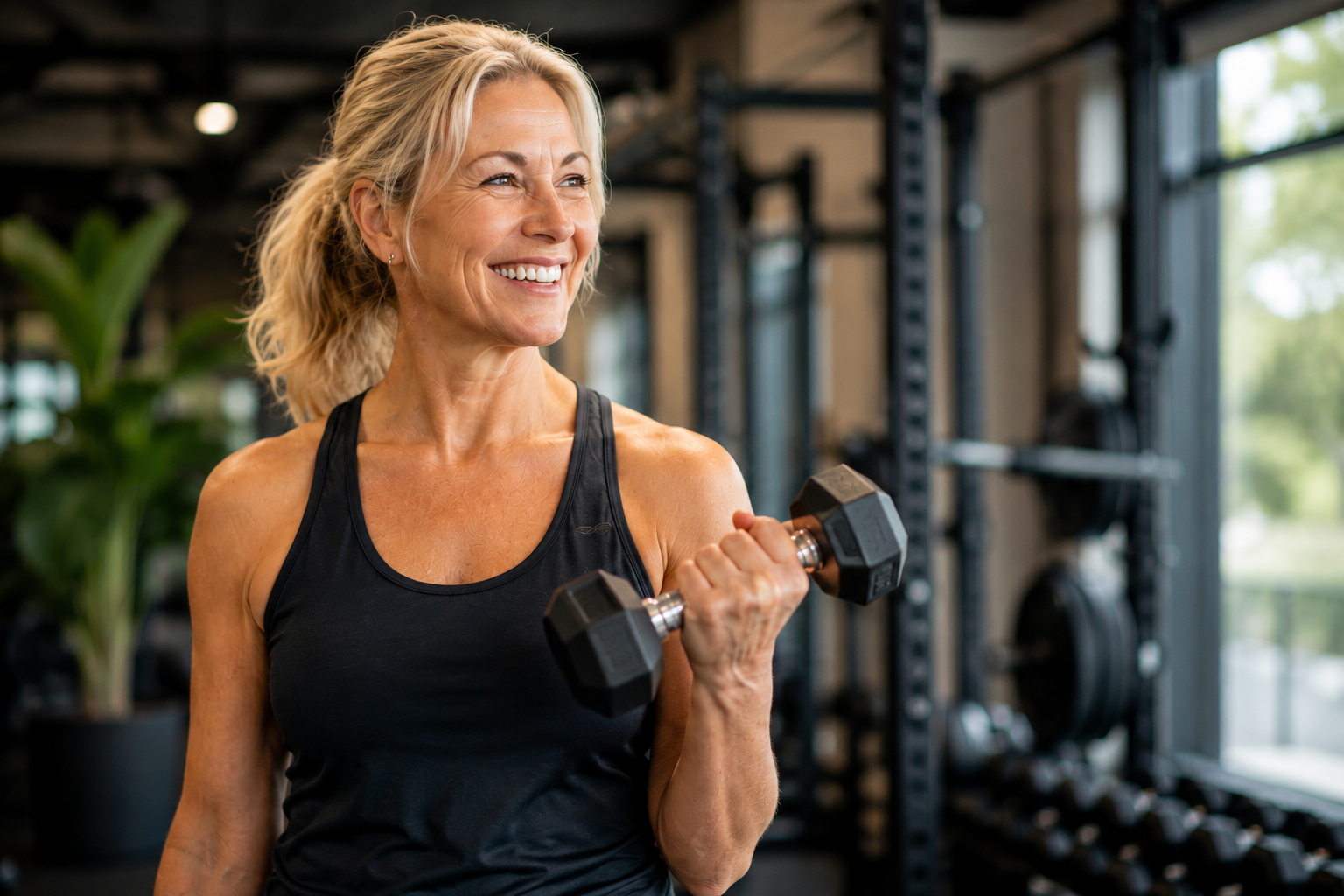
Strength training is arguably the most important form ofexercise during perimenopause and menopause.
Lifting progressively heavier loads helps:
- maintain muscle mass
- increase strength
- improve bone density
- support healthy joints
- improve balance
- reduce falls risk
- make everyday activities easier.
Importantly, strength training does not mean becomingbulky. Women simply do not have the hormonal environment to develop largeamounts of muscle in the same way men do.
Instead, strength training helps women become stronger, morecapable and more resilient.
Current guidelines recommend resistance training at least two to three times each week, targeting all major muscle groups (ACSM, 2024).
2. Weight-bearing and impact exercise
Bones need challenge to remain strong.
Activities such as brisk walking, stair climbing, skipping,jogging, hopping and jumping provide important loading for bone. For women withlow bone density or osteoporosis, these activities should be individualised andprogressed safely under professional guidance.
Research shows that appropriately prescribed resistance andimpact training can significantly improve bone health and reduce fracture risk(Watson et al., 2018; Giangregorio et al., 2022).
3. Cardiovascular exercise
Aerobic exercise supports:
- heart health
- blood pressure
- cholesterol
- insulin sensitivity
- mood
- sleep quality.
Aim for at least 150 minutes of moderate-intensityactivity each week, such as brisk walking, cycling or swimming, or 75minutes of vigorous activity (WHO, 2020).
4. Balance and mobility
Balance naturally declines with age, increasing the risk offalls.
Simple exercises that challenge balance, combined withstrength training, can significantly reduce this risk (Sherrington et al.,2020).
Mobility exercises also help maintain joint movement andreduce stiffness.
Exercise helps more than your body
One of the most overlooked benefits of exercise is itseffect on mental wellbeing.
Regular physical activity has been shown to improve:
- mood
- anxiety
- sleep quality
- confidence
- energy evels
- overall quality of life during menopause (Daley et al., 2021).
Many women also report feeling more in control of theirbodies and more confident returning to activities they enjoy.
It's never too late to start
Perhaps the most encouraging message is that your bodycontinues to respond to exercise throughout life.
Whether you're 45 or 75, muscles become stronger whenchallenged. Bones adapt to appropriate loading. Balance improves with practice.
Small, consistent changes often produce the biggestlong-term results.
How can a pelvic health physiotherapist help?
Exercise should never be one-size-fits-all.
A pelvic health physiotherapist can assess your strength,pelvic floor, balance, movement patterns and exercise goals before developingan individualised program that suits your body and your stage of life.
Whether you're experiencing bladder leakage, joint pain,reduced confidence at the gym or simply don't know where to begin, the rightadvice can help you exercise safely and effectively.
Menopause isn't the end of an active life—it can be thebeginning of a stronger one.
References
American College of Sports Medicine. (2024). ACSMPosition Statement: Resistance Exercise for Health and Performance.
Bull, F. C., et al. (2020). World Health Organization 2020guidelines on physical activity and sedentary behaviour. British Journal ofSports Medicine, 54(24), 1451–1462.
Daley, A. J., Thomas, A., Roalfe, A. K., et al. (2021). Theeffectiveness of exercise as treatment for vasomotor menopausal symptoms: Asystematic review and meta-analysis. BJGP Open, 5(3).
Daly, R. M., Gianoudis, J., & Beck, B. R. (2023).Exercise recommendations for women across the menopause transition. Journalof Clinical Medicine, 12, 4308.
Giangregorio, L. M., McGill, S., Wark, J. D., et al. (2022).Too Fit To Fracture: Exercise recommendations for individuals with osteoporosisor osteoporotic vertebral fracture. Osteoporosis International, 33,821–835.
Sherrington, C., Fairhall, N., Wallbank, G., et al. (2020).Exercise for preventing falls in older people living in the community. BritishJournal of Sports Medicine, 54(15), 885–891.
The Menopause Society. (2023). The Menopause Guidebook(10th ed.).
Watson, S. L., Weeks, B. K., Weis, L. J., Horan, S. A.,& Beck, B. R. (2018). High-intensity resistance and impact trainingimproves bone mineral density and physical function in postmenopausal womenwith low bone mass: The LIFTMOR trial. Journal of Bone and Mineral Research,33(2), 211–220.
World Health Organization. (2020). WHOGuidelines on Physical Activity and Sedentary Behaviour.
Not sure if Physiotherapy is the best option or want some quick advice?
Email our team and a Physiotherapist will contact you within 1 working day
