Why Walking Isn’t Enough: The Missing Piece in Women’s Exercise
Walking is one of the best forms of movement we can do.
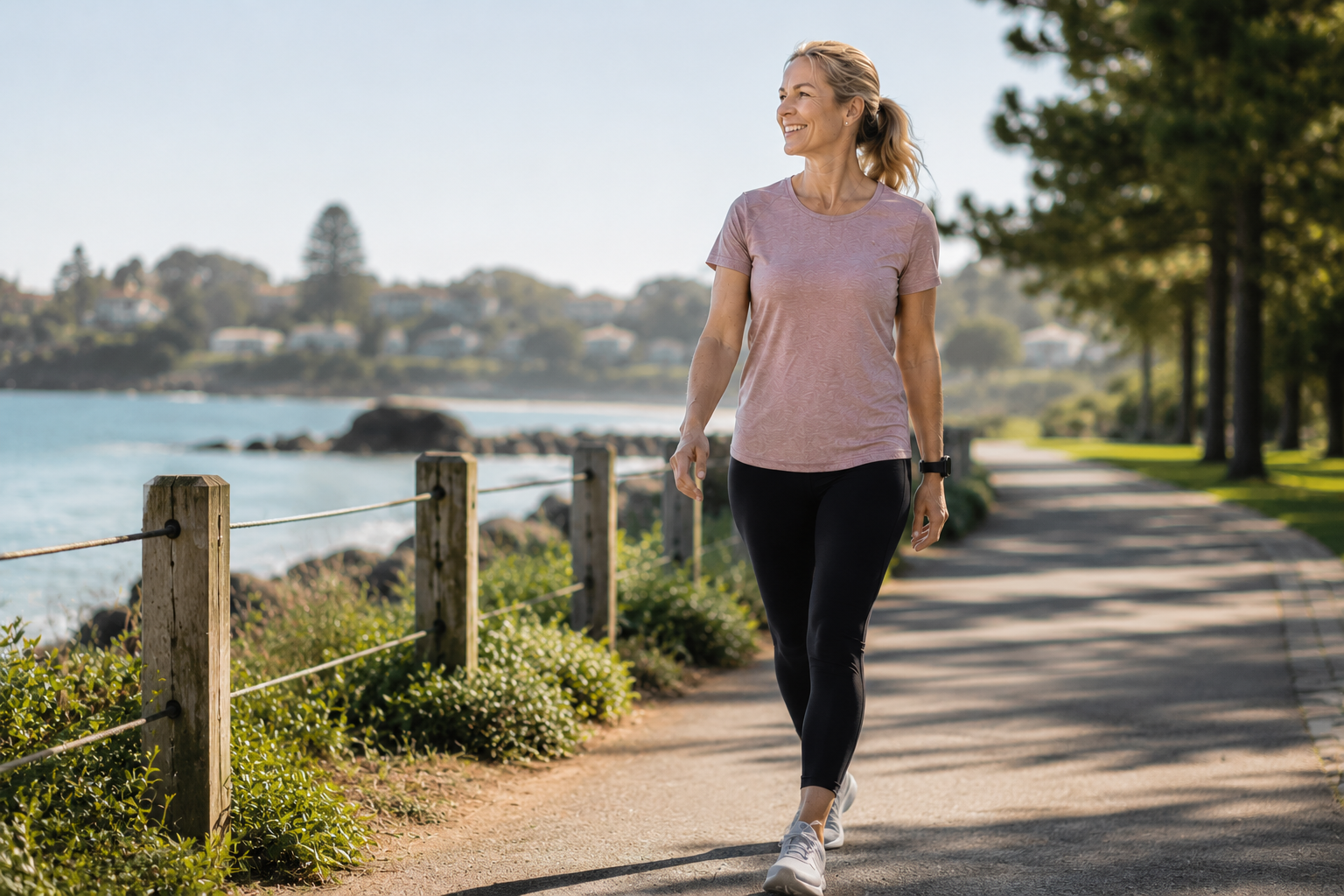
It’s accessible, inexpensive and good for our heart, lungs, mental health and general wellbeing. A brisk walk can improve cardiovascular fitness, reduce stress and help us meet recommended physical activity levels (World Health Organization [WHO], 2020).
So, if you love walking, please keep walking!
But there is an important message for women, particularly as we move through our 40s, perimenopause, menopause and beyond:
Walking is fantastic exercise, but walking alone is not enough to protect everything we want to protect as we age.
Why does exercise need to change as we get older?
From midlife onwards, maintaining muscle, strength and bone density becomes increasingly important.
Ageing is associated with gradual losses in muscle mass and strength. Around menopause, changes in oestrogen may also contribute to changes in muscle, bone and body composition.
Exercise can make a meaningful difference. A large 2023 systematic review involving more than 5,600 postmenopausal women found that exercise improved body composition. Importantly, resistance and combined training were particularly beneficial for increasing muscle mass (Khalafi etal., 2023).
The key is providing the body with enough stimulus to adapt.
Why doesn’t walking provide everything we need?
Walking is repetitive and relatively low impact.
That is part of what makes it so safe and enjoyable. However, it also means that your muscles and bones quickly become accustomed to the load.
Bone is particularly sensitive to unusual, higher and rapidly applied loads. This is why resistance training and appropriately prescribed impact exercise provide a different stimulus from everyday walking.
Current osteoporosis exercise recommendations therefore include progressive resistance training and impact exercise, rather than relying on walking alone (Brooke-Wavell et al., 2022; Healthy Bones Australia& RACGP, 2024).
The missing piece: strength training
Strength training means working your muscles against resistance.
That resistance might come from:
- dumbbells or barbells
- gym machines
- resistance bands
- kettlebells
- or your own body weight.
The important word is progressive.
If you repeatedly lift a weight that has become easy, yourbody has little reason to become stronger. Over time, the resistance needs to increase as your ability improves.
International physical activity guidelines recommend that adults perform muscle-strengthening exercise involving all major muscle groupson at least two days each week (WHO, 2020).
For women approaching or beyond menopause, this becomes particularly valuable.
Your bones need challenge too
Bones are living tissue. They respond to the forces placed through them.
Activities such as jumping, hopping, skipping and other weight-bearing impact exercises can provide an important stimulus for bone.
For women with osteoporosis or osteopenia, research and current clinical guidelines support combining resistance and appropriate impact exercise to help maintain or improve bone strength (Brooke-Wavell et al., 2022;Kim et al., 2023).
However, impact exercise needs to suit the individual. Previous fractures, osteoporosis, pelvic floor symptoms, joint problems and exercise experience can all change what is appropriate.
What about the pelvic floor?
Having pelvic floor symptoms does not automatically mean you need to avoid lifting, running or jumping.
If you experience leaking, vaginal heaviness or pelvic pressure during exercise, it is worth having this assessed rather than simply removing challenging exercise forever.
Often, we can modify the load, improve pelvic floor function and gradually build your body's capacity.
So, what should a balanced week look like?
There isn't one perfect exercise program for every woman, but a well-rounded week should generally include a mixture of:
- aerobic exercise such as walking, cycling or swimming
- progressive resistance training at least twice per week
- impact or weight-bearing exercise where appropriate
- balance and mobility work
- and enough recovery to allow your body to adapt.
You don't need to stop walking.
You simply need to add to it.
How can physiotherapy help?
If you've always been a walker and don't know where to startwith weights, you're certainly not alone.
A physiotherapist can assess your current strength, bone health, injuries, pelvic floor symptoms and exercise experience before helping you build an appropriate program.
Strength training doesn't have to be intimidating, and you don't need to become a gym person overnight.
Start where you are. Learn how to lift well. Progress gradually.
Keep walking—but give your muscles and bones something more to respond to as well.
References
Brooke-Wavell, K., Skelton, D. A., Barker, K. L., et al.(2022). Strong, steady and straight: UK consensus statement on physicalactivity and exercise for osteoporosis. British Journal of Sports Medicine,56(15), 837–846.
Bull, F. C., Al-Ansari, S. S., Biddle, S., et al. (2020).World Health Organization 2020 guidelines on physical activity and sedentary behaviour. British Journal of Sports Medicine, 54(24), 1451–1462.
Healthy Bones Australia & Royal Australian College ofGeneral Practitioners. (2024). Osteoporosis management and fractureprevention in postmenopausal women and men over 50 years of age.
Khalafi, M., et al. (2023). The effects of exercise trainingon body composition in postmenopausal women: A systematic review andmeta-analysis. Frontiers in Endocrinology, 14, 1183765.
Kim, Y., et al. (2023). Position statement: Exercise guidelines for osteoporosis management and fall prevention in osteoporosis patients. Journal of Bone Metabolism, 30(2), 149–165.
Sherrington, C., Fairhall, N., Wallbank, G., et al. (2020). Exercise for preventing falls in older people living in the community. British Journal of Sports Medicine, 54(15), 885–891.
Watson, S. L., Weeks, B. K., Weis, L. J., Horan, S. A.,& Beck, B. R. (2018). High-intensity resistance and impact training improves bone mineral density and physical function in postmenopausal women with low bone mass: The LIFTMOR randomized controlled trial. Journal of Bone and Mineral Research, 33(2), 211–220.
World Health Organization. (2020). WHO guidelines on physical activity and sedentary behaviour.
Not sure if Physiotherapy is the best option or want some quick advice?
Email our team and a Physiotherapist will contact you within 1 working day
